Guanosine has a maximum absorbance of 275 nm. ϵ275=8400M−1cm−1 and the path length is 1 cm. Using a spectrophotometer, you find the that A275=0.70. What is the concentration of guanosine?
Spectrophotometry is a method to measure how much a chemical substance absorbs light by measuring the intensity of light as a beam of light passes through sample solution. The basic principle is that each compound absorbs or transmits light over a certain range of wavelength. This measurement can also be used to measure the amount of a known chemical substance. Spectrophotometry is one of the most useful methods of quantitative analysis in various fields such as chemistry, physics, biochemistry, material and chemical engineering and clinical applications.
Introduction
Every chemical compound absorbs, transmits, or reflects light (electromagnetic radiation) over a certain range of wavelength. Spectrophotometry is a measurement of how much a chemical substance absorbs or transmits. Spectrophotometry is widely used for quantitative analysis in various areas (e.g., chemistry, physics, biology, biochemistry, material and chemical engineering, clinical applications, industrial applications, etc). Any application that deals with chemical substances or materials can use this technique. In biochemistry, for example, it is used to determine enzyme-catalyzed reactions. In clinical applications, it is used to examine blood or tissues for clinical diagnosis. There are also several variations of the spectrophotometry such as atomic absorption spectrophotometry and atomic emission spectrophotometry.
A spectrophotometer is an instrument that measures the amount of photons (the intensity of light) absorbed after it passes through sample solution. With the spectrophotometer, the amount of a known chemical substance (concentrations) can also be determined by measuring the intensity of light detected. Depending on the range of wavelength of light source, it can be classified into two different types:
UV-visible spectrophotometer: uses light over the ultraviolet range (185 - 400 nm) and visible range (400 - 700 nm) of electromagnetic radiation spectrum.
IR spectrophotometer: uses light over the infrared range (700 - 15000 nm) of electromagnetic radiation spectrum.
In visible spectrophotometry, the absorption or the transmission of a certain substance can be determined by the observed color. For instance, a solution sample that absorbs light over all visible ranges (i.e., transmits none of visible wavelengths) appears black in theory. On the other hand, if all visible wavelengths are transmitted (i.e., absorbs nothing), the solution sample appears white. If a solution sample absorbs red light (~700 nm), it appears green because green is the complementary color of red. Visible spectrophotometers, in practice, use a prism to narrow down a certain range of wavelength (to filter out other wavelengths) so that the particular beam of light is passed through a solution sample.
Devices and mechanism
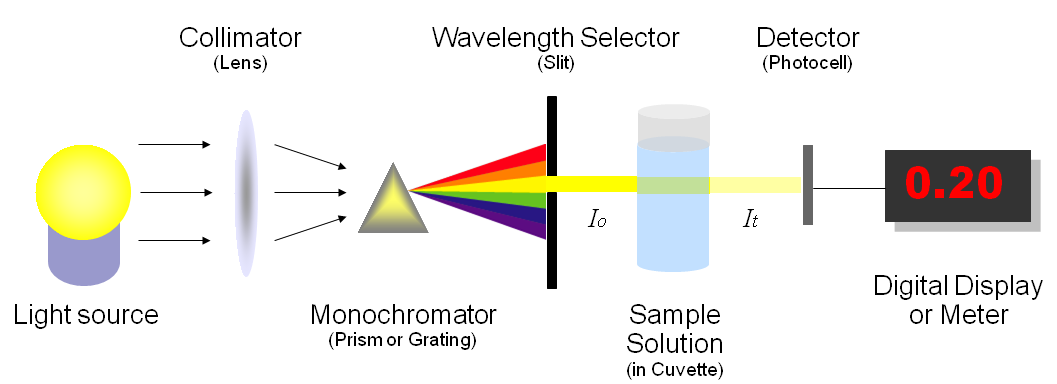
Figure 1 illustrates the basic structure of spectrophotometers. It consists of a light source, a collimator, a monochromator, a wavelength selector, a cuvette for sample solution, a photoelectric detector, and a digital display or a meter. Detailed mechanism is described below. Figure 2 shows a sample spectrophotometer (Model: Spectronic 20D).
Figure 1: Basic structure of spectrophotometers (illustrated by Heesung Shim)
A spectrophotometer, in general, consists of two devices; a spectrometer and a photometer. A spectrometer is a device that produces, typically disperses and measures light. A photometer indicates the photoelectric detector that measures the intensity of light.
Spectrometer: It produces a desired range of wavelength of light. First a collimator (lens) transmits a straight beam of light (photons) that passes through a monochromator (prism) to split it into several component wavelengths (spectrum). Then a wavelength selector (slit) transmits only the desired wavelengths, as shown in Figure 1.
Photometer: After the desired range of wavelength of light passes through the solution of a sample in cuvette, the photometer detects the amount of photons that is absorbed and then sends a signal to a galvanometer or a digital display, as illustrated in Figure 1.
Figure 2: A single wavelenth spectrophotometer
You need a spectrometer to produce a variety of wavelengths because different compounds absorb best at different wavelengths. For example, p-nitrophenol (acid form) has the maximum absorbance at approximately 320 nm and p-nitrophenolate (basic form) absorb best at 400nm, as shown in Figure 3.
Figure 3: Absorbance of two different compounds
Looking at the graph that measures absorbance and wavelength, an isosbestic point can also be observed. An isosbestic point is the wavelength in which the absorbance of two or more species are the same. The appearance of an isosbestic point in a reaction demonstrates that an intermediate is NOT required to form a product from a reactant. Figure 4 shows an example of an isosbestic point.
Figure 4: An example of isosbestic point
Referring back to Figure 1 (and Figure 5), the amount of photons that goes through the cuvette and into the detector is dependent on the length of the cuvette and the concentration of the sample. Once you know the intensity of light after it passes through the cuvette, you can relate it to transmittance (T). Transmittance is the fraction of light that passes through the sample. This can be calculated using the equation:
Transmittance(T)=ItIo
Where It is the light intensity after the beam of light passes through the cuvette and Io is the light intensity before the beam of light passes through the cuvette. Transmittance is related to absorption by the expression:
Absorbance(A)=−log(T)=−log(ItIo)
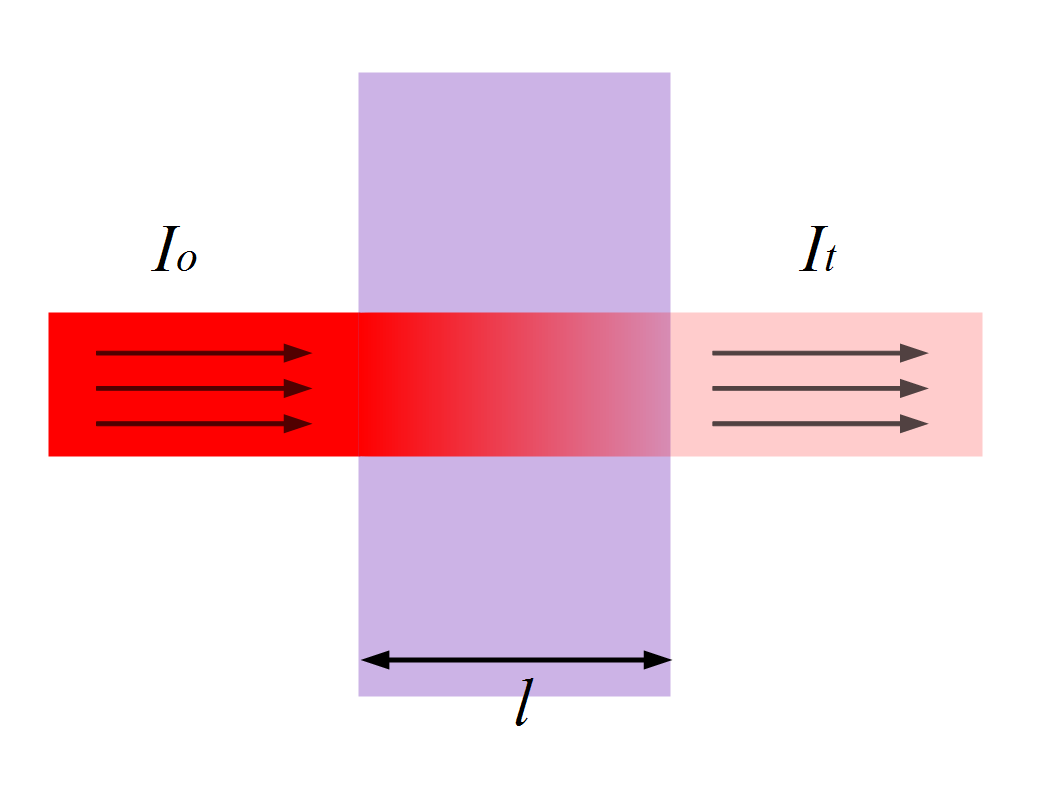
Where absorbance stands for the amount of photons that is absorbed. With the amount of absorbance known from the above equation, you can determine the unknown concentration of the sample by using Beer-Lambert Law. Figure 5 illustrates transmittance of light through a sample. The length l is used for Beer-Lambert Law described below.
Figure 5: Transmittance (illustrated by Heesung Shim)
Beer-Lambert Law
Beer-Lambert Law (also known as Beer's Law) states that there is a linear relationship between the absorbance and the concentration of a sample. For this reason, Beer's Law can only be applied when there is a linear relationship. Beer's Law is written as:
A=ϵlc
where
A is the measure of absorbance (no units),
ϵ is the molar extinction coefficient or molar absorptivity (or absorption coefficient),
l is the path length, and
c is the concentration.
The molar extinction coefficient is given as a constant and varies for each molecule. Since absorbance does not carry any units, the units for ϵ must cancel out the units of length and concentration. As a result, ϵ has the units: L·mol-1·cm-1. The path length is measured in centimeters. Because a standard spectrometer uses a cuvette that is 1 cm in width, l is always assumed to equal 1 cm. Since absorption, ϵ, and path length are known, we can calculate the concentration c of the sample.
The new elements – elements 113, 115, 117 and 118 – complete the periodic table’s seventh row and make science textbooks around the world instantly out-of-date.
The completed seventh row in the periodic table. Image credit: Wikimedia Commons
In an event likely never to be repeated, four new superheavy elements were last weeksimultaneously added to the periodic table. To add four in one go is quite an achievement but the race to find more is ongoing.
Back in 2012, the International Unions of Pure and Applied Chemistry (IUPAC) and Pure and Applied Physics (IUPAP) tasked five independent scientists to assess claims made for the discovery of elements 113, 115, 117 and 118. The measurements had been made at Nuclear Physics Accelerator laboratories in Russia (Dubna) and Japan (RIKEN) between 2004 and 2012.
Late last year, on December 30, 2015, IUPAC announced that claims for the discovery of all fournew elements had been accepted.
This completes the seventh row of the periodic table, and means that all elements between hydrogen (having only one proton in its nucleus) and element 118 (having 118 protons) are now officially discovered.
After the excitement of the discovery, the scientists now have the naming rights. The Japanese team will suggest the name for element 113. The joint Russian/US teams will make suggestions for elements 115, 117 and 118. These names will be assessed by IUPAC, and once approved, will become the new names that scientists and students will have to remember.
Until their discovery and naming, all superheavy elements (up to 999!) have been assigned temporary names by the IUPAC. Element 113 is known as ununtrium (Uut), 115 is ununpentium (Uup), 117 is ununseptium (Uus) and 118 ununoctium (Uuo). These names are not actually used by physicists, who instead refer to them as “element 118”, for example.
The superheavy elements
Elements heavier than Rutherfordium (element 104) are referred to as superheavy. They are not found in nature, because they undergo radioactive decay to lighter elements.
Those superheavy nuclei that have been created artificially have decay lifetimes between nanoseconds and minutes. But longer-lived (more neutron-rich) superheavy nuclei are expected to be situated at the centre of the so-called “island of stability”, a place where neutron-rich nuclei with extremely long half-lives should exist.
Currently, the isotopes of new elements that have been discovered are on the “shore” of this island, since we cannot yet reach the centre.
How were these new elements created on Earth?
Atoms of superheavy elements are made by nuclear fusion. Imagine touching two droplets of water – they will “snap together” because of surface tension to form a combined larger droplet.
The problem in the fusion of heavy nuclei is the large numbers of protons in both nuclei. This creates an intense repulsive electric field. A heavy-ion accelerator must be used to overcome this repulsion, by colliding the two nuclei and allowing the nuclear surfaces to touch.
This is not sufficient, as the two touching spheroidal nuclei must change their shape to form a compact single droplet of nuclear matter – the superheavy nucleus.
It turns out that this only happens in a few “lucky” collisions, as few as one in a million.
There is yet another hurdle; the superheavy nucleus is very likely to decay almost immediately by fission. Again, as few as one in a million survives to become a superheavy atom, identified by its unique radioactive decay.
The process of superheavy element creation and identification thus requires large-scale accelerator facilities, sophisticated magnetic separators, efficient detectors and time.
Finding the three atoms of element 113 in Japan took 10 years, and that was after the experimental equipment had been developed.
The payback from the discovery of these new elements comes in improving models of the atomic nucleus (with applications in nuclear medicine and in element formation in the universe) and testing our understanding of atomic relativistic effects (of increasing importance in the chemical properties of the heavy elements). It also helps in improving our understanding of complex and irreversible interactions of quantum systems in general.
The race to make more elements
The race is now on to produce elements 119 and 120. The projectile nucleus Calcium-48 (Ca-48) – successfully used to form the newly accepted elements – has too few protons, and no target nuclei with more protons are currently available. The question is, which heavier projectile nucleus is the best to use.
To investigate this, the leader and team members of the German superheavy element research group, based in Darmstadt and Mainz, recently travelled to the Australian National University.
They made use of unique ANU experimental capabilities, supported by the Australian Government’s NCRIS program, to measure fission characteristics for several nuclear reactions forming element 120. The results will guide future experiments in Germany to form the new superheavy elements.
It seems certain that by using similar nuclear fusion reactions, proceeding beyond element 118 will be more difficult than reaching it. But that was the feeling after the discovery of element 112, first observed in 1996. And yet a new approach using Ca-48 projectiles allowed another six elements to be discovered.
Nuclear physicists are already exploring different types of nuclear reaction to produce superheavies, and some promising results have already been achieved. Nevertheless, it would need a huge breakthrough to see four new nuclei added to the periodic table at once, as we have just seen.